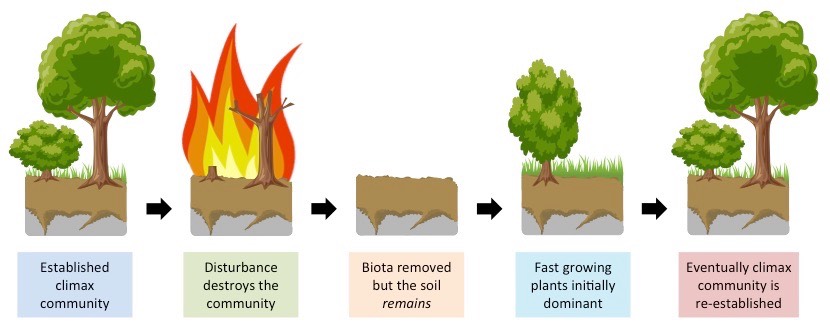
“Ecosystems are not permanent; nature is constantly changing. Two essential and related processes of change are disturbance and succession.” (Robertson et al., 35). This line is a reminder that earth is not static and that there is always something happening in order for the earth to remain in equilibrium. To maintain this equilibrium, disturbance must occur and succession will follow. A disturbance is a catastrophic event to an ecosystem that typically allows for new life forms to emerge and permits a growth in population density. An example of a catastrophe is when a wildfire starts to burn down a forest (figure 1). This event is devastating to the community, but succession will occur over time to allow for more diversity, or added in this example, better soil quality to reform. Being able to understand how devastation and succession is beneficial to the environment is one key to learning how to preserve ecosystems. When the ecosystem has time to readjust to the climax and regain its health from the initially dominant lifeforms, a possible stronger, new community climax is reached.
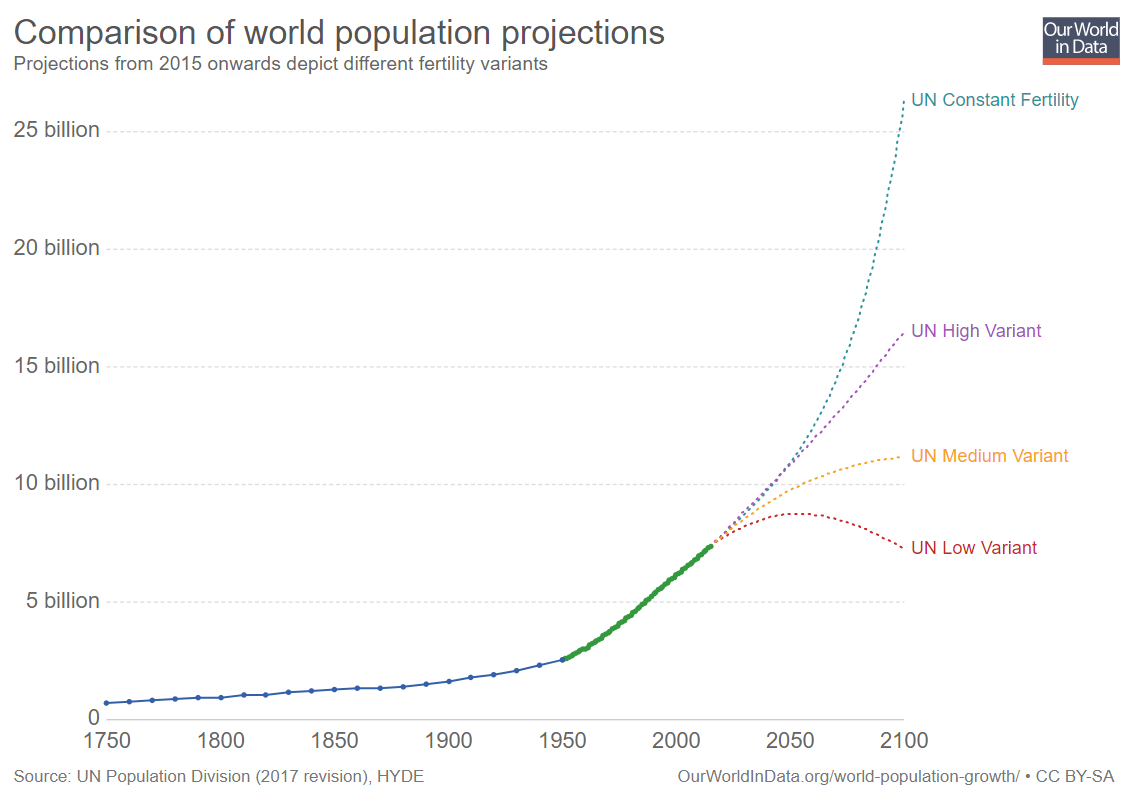
After learning more about destruction and succession it is important to look at the human population growth rate in order to see how the rate is changing with the environment and ecosystem. According to Robertson et al. on page 46, ” Over the past century the planet’s population quadrupled from 1.5 billion to 6 billion, with a billion people added to the planet every 33 years on average.” This increase gives people an idea of how many resources are being used to accommodate this dramatic change of population in 100 years. The UN has created a graph of the future population growth estimations. The graph has four possible outcomes: a UN constant fertility, UN high, UN medium, and UN low variant (figure 2)(Roser). According to their calculations, the estimated population by the year 2050 will be 9.7 billion (Robertson et al; Roser). Many countries have been pushing education and working with demographic transitions in order to lower the population rate so that it can stay at a constant rate. The constant rate will allow for researchers to determine what is best for the earth, while avoiding a decrease in population.
With the rise of human population the worry about another mass extension is increasing. According to Roberston et al., page 50, “The planet’s sixth mass extinction is underway, with 50 percent of species alive today predicted to be gone by the year 2100 (Wilson 2002b, 102)”. Evidence of this is the loss of 90% of fish in the ocean and oxygen being pulled out from the ocean and leaving dead zones due to soil runoff. This sixth mass extinction that is killing oceanic animals and melting glaciers is because of humans. Humans are allowing fertilizers to runoff into the ocean, streams, and rivers that can cause the dead zones in the ocean and keeping away life. People have also increased industrial processes that allow for smoke to go into the air and mix with oxygen. Scientists believe that people are transforming the environment and that carbon dioxide is entering the atmosphere at higher rates than before. The rise of carbon dioxide and toxic agents, in things like fertilizers, is harming the earth and taking away from future resources that can be used for generations to come. The video below describes how the sixth mass extinction event is forming and how humans are the sole contributors to this event.
Sources
Cornell, Brent. (n.d.). Retrieved May 23, 2019, from https://ib.bioninja.com.au/options/option-c-ecology-and-conser/c2-communities-and-ecosyste/ecological-disturbance.html Robertson, M. (2017). Sustainability Principles and Practice. Abingdon, Oxon: Routledge. Roser, M. (2013, May 09). Future Population Growth. Retrieved May 23, 2019, from https://ourworldindata.org/future-population-growth

 Alexandria's Blog on Sustainability