The changing of the climate is inevitable over time and should be expected over a 150 year period. While observing the climate change scientists found that the temperature is rising faster now than it has in the past. They call this sudden rise global warming. This “fast paced” change is partly due to humans and the increase in fossil fuel usage we burn through. Another discovery is that earth’s fresh-water source is being depleted faster than it can be used.
It can easily be assumed that earth is getting warmer, but how do we know it is heating faster than before? The answer is that we use proxies. According to Robertson (2017), “for measurements before 150 years ago, scientists use proxies: indicators that stand in for temperature.” Two examples of biological proxies are tree rings and coral reef rings. Trees form rings that respond to temperature while corals form rings that show water temperature (figure 1). Both rings compliment each other to understand the changing weather since tree rings work best for temperate regions and coral reef rings form in tropical regions.

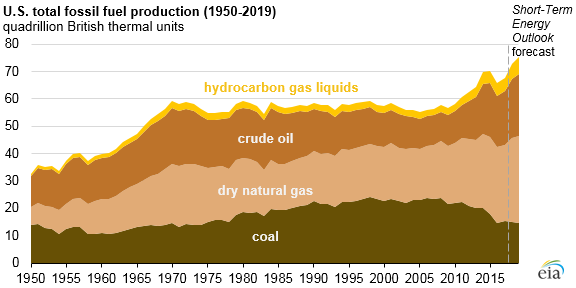
The rings and other proxies show a rise in temperature. This increase is due to the amount of carbon dioxide on earth that can warm up the atmosphere over time. According to Robertson (2017) on page 74 “since the start of the industrial era the concentration of CO2 in the atmosphere has risen almost 40 percent (Houghton 2009, 29). The burning of fossil fuels is the primary culprit…”. The amount of carbon dioxide is increasing at 2 parts per million a year. The 2 ppm rise of carbon dioxide correlates to the exponential use of fossil fuels per year. According to the EIA, the use of fossil fuels will increase by 9% from 2017-2019 (figure 2). The expected main contributors to the increase usage of fossil fuels are natural gas and crude oil. It is important to find other uses of power, like electric cars, in order to decrease this use and minimize the amount of carbon dioxide emissions. Otherwise the increase use of fossil fuels and output of CO2 keep may be harmful to the earth’s environment and can keep holding the heat in.
The second discovery made when looking at earth’s resources were that aquifers are being depleted. Aquifers are used for drinking water and farming and are a necessary resource to our daily lives. Since aquifers are so important they have been used often. In fact, they have been used so often that they are depleting faster than they can refill. An example o this is with an important aquifer known as the Ogallala Aquifer. “The Ogallala is for all practical purposes a nonrenewable resource, and it is disappearing.” (Robertson 2017). The volume of the Ogallala has dropped 11% since it started being used in the 1950s. In some parts of its long stretch through different states the water table has dropped 100-150 feet (Robertson 2017). The video below explains more about the Ogallala Aquifer and its importance to the society, along with how it is being depleted.
Hess, T. (2018, January 18). U.S. Energy Information Administration – EIA – Independent Statistics and Analysis. Retrieved from https://www.eia.gov/todayinenergy/detail.php?id=34572
NASA Earth Observatory. Paleoclimatology: Climate Close-up. (2005, December 23). Retrieved from https://earthobservatory.nasa.gov/features/Paleoclimatology_CloseUp/paleoclimatology_closeup_2.php Robertson, M. (2017). Sustainability Principles and Practice. Abingdon, Oxon: Routledge. Tufts ENVS. Resource Depletion of the Ogallala Aquifer. (2017, June 14). Retrieved from https://www.youtube.com/watch?v=j1MGJQmdQKk

 Alexandria's Blog on Sustainability